What can leave?
.jpg)
This article by Karina McHardy was originally published as ‘Subtraction’ on her Substack NeuroThrive and is reposted here with permission.
Weekends have acquired a mythology all of their own. They appear in conversation as spacious things. A chance to catch up, slow down, recover before Monday arrives. People ask whether we have anything planned, as though the absence of plans might leave room for rest. Our weekends have rarely looked like that.
By Friday evening, the week has usually left its mark. There are mountains of practical jobs waiting to be done, routines that need rebuilding, various signals that one demanding day has followed another. Life hasn’t paused because the calendar has reached Saturday. If anything, it asks more of us. We have longer stretches with the children, less external structure, and the accumulated effects of the week to absorb before they gather enough momentum to become harder to unwind.
Some weekends move reasonably enough, while others begin at full volume.
A few weeks ago was one of those.
I can’t remember what started it, which probably tells its own story. The morning just refused to find a rhythm. Minor frustrations collected without ever resolving. Every next interruption presented itself before the previous one had settled. I moved at pace from one unfinished task to the next, uncomfortably aware that I was already behind despite having been awake for only a few hours.
Stress tends to shrink my world at moments like these. Decisions become unusually expensive; ordinary questions require more thought than they should. Even basic conversations can feel as though they contain one sentence too many.
By 9 o’clock, I’d become spectacularly bad company.
My husband noticed before I said anything. He had watched the previous week play out, and the one before that. He knew I’d been stretching further than was sensible for longer than I dared to admit. He suggested taking the children out for a while so I could have the house to myself.
It was a thoughtful offer. It also felt as though we were trying to solve something that all of us were living through.
The children were frayed too. They had their own version of the morning written across their faces. One was moving far faster than anyone else. The other had become wonderfully inventive at finding reasons to disagree. Every tiny wobble seemed to travel through the whole house, gathering strength as it went.
Without giving myself much time to think, I found a bag and filled it with fruit, muesli bars, water bottles, and spare clothes. Everything else stayed where it was.
Shoes were sourced, toilet trips encouraged, the inevitable set of complaints negotiated. We climbed into the car, and I pointed us away from the city.
I chose a walking track I’d been wanting to explore for close to a decade. The car park was little more than a muddy strip beside the road. We stepped carefully around puddles, found the entrance to the track, and just started walking.
And then, nothing happened. At least, nothing you would photograph.
The path wound through tall trees that had been standing there long before any of us arrived. A river appeared alongside us, disappeared again, then returned around another bend. Other walkers smiled as we passed. The children marched ahead, occasionally needing reminders to stay close, inventing games that required no equipment beyond sticks, stones, and whatever else their imaginations supplied. Conversation returned without anyone needing to try very hard.
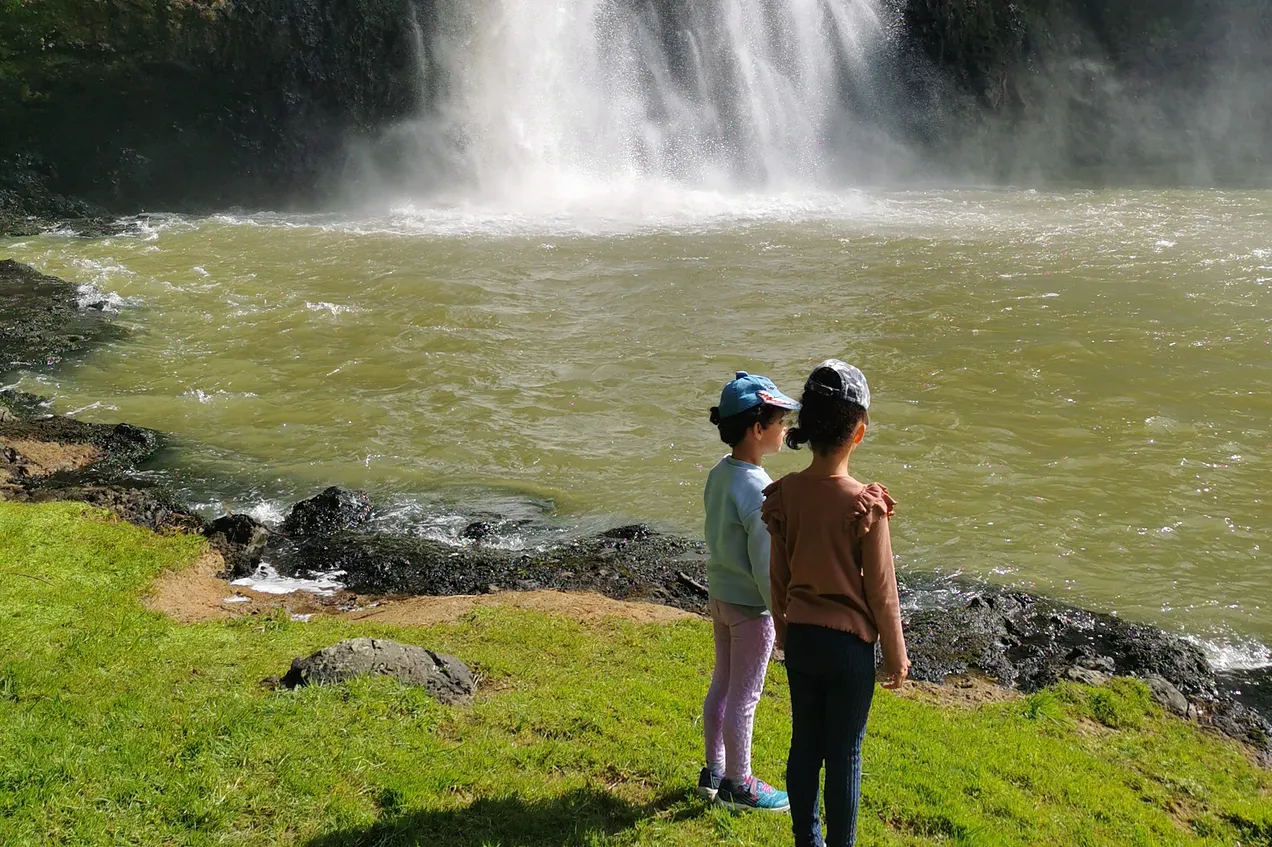
Eventually we reached a stunning waterfall, the advertised drawcard of the track. We stayed there for a while, eating the snacks I’d thrown into the bag with considerably less planning than usual. The spray reached us every now and then, cool enough to make Matilda and Max squeal before edging closer again.
When we turned back towards the car, the mood of the day had changed. We weren’t transformed. We were simply different.
The rest of the afternoon unfolded without the sense that every moment might tip into the next unravelling. We ate dinner, baths happened, and stories were chosen before our watches announced bedtime. Everyone slept. In our house, that last sentence always holds more weight than it might appear to. It was less something we had worked for in that moment, and more something we had allowed.
I find myself returning to the memory of that walk, partly because there was nothing remarkable about it. We didn’t solve anything. The coming week remained exactly as full as it had been that morning. The responsibilities we managed hadn’t dissolved while we stood beside a waterfall. The shape of our day altered anyway.
Perhaps because so little was being asked of us, what changed wasn’t a solution so much as a break in what had been building. Some things stopped being borne in the same way, without ceremony or decision.
There was no timetable to stick to. No outcome to tick off. Nobody needed persuading or managing. We walked, ate, talked when we felt like it, and kept following the path because there was only one direction to go.
I’ve started noticing how I instinctively respond to complexity by introducing more of it. Maybe adding creates the sense that we’re moving forwards, even when we’re mostly adding to what already seems like too much. We reach for another idea, another strategy, another discussion, another thing to remember, hoping one more layer might steady what feels unsteady.
Lately I’ve been asking a different question altogether.
What can leave?
It’s a question that now seems to surface in unexpected places, including conversations about children with additional needs.
Support has a way of becoming crowded. Meetings generate actions, reports generate recommendations, recommendations become programmes, and every addition is coupled with good intentions. Over time, entire days become densely populated with things that ought to help. Mornings can feel as though every part of them is already spoken for, before they’ve properly started.
Sometimes the hardest part of the morning begins before the school bell rings. Breakfast has become rushed. There hasn’t quite been enough time to work on tying shoelaces without everyone feeling the clock. The spelling words are squeezed into the few minutes between brushing teeth and filling water bottles.
Sometimes the next useful change is making room. A rushed morning that no longer has to carry spelling practice. Shoelaces that can wait until after school. One — just one — less thing competing for attention.
Over the years I’ve met professionals whose work reflects that quality. They don’t seem in a hurry to make things busier. They ask careful questions, pay close attention, and resist filling every space with another suggestion. Their confidence looks like restraint. They’re comfortable leaving only the parts that genuinely need to remain.
I’ve become increasingly suspicious of the instinct to keep adding. Some of the biggest shifts in our house actually followed days that asked a little less of everyone.
I can still see the children walking ahead of us, stopping every few metres to source a curiously shaped stick or throw stones into the river, completely absorbed in things that couldn’t be hurried. I remember how the track kept winding just enough that we could never see very far in front of us.
I think that’s another reason the day felt lighter. We weren’t trying to carry all of Monday, or the next week, or everything that still needed attention.
The track never asked us to see all the way to the end — only to the next bend.
That was enough for one Sunday.