
Making sense of school reporting and learning progress

School reporting to parents has changed as a new reporting format has been rolled out, and as more schools adopt SMART (Student Monitoring, Assessment and Reporting Tool) over the coming months.
You may have noticed a change in wording in your child’s most recent school reports for Year 0-10 in Reading, Writing and Maths that were sent home.
For parents of children with complex learning needs, these kinds of changes can set off alarm bells and create fear that your child will be left behind. But the best way to reassure yourself is to understand what has changed with the reporting mechanism, what it means for your child and what you can do as a parent to support them.
What’s changed?
Teachers are now using a five-part scale with ‘progress descriptors’ to measure your child’s progress with the curriculum. Many schools were already using a five-part scale, so for some reports, little has changed.
Where things get a little tricky is that some of the curriculum expectations for learners are new, and the knowledge and skills required for your child to meet the progress descriptors may not have been covered yet in their classroom. Students can’t be ‘proficient’ at a topic if they haven’t even been exposed to ot taught it in the classroom yet.
Schools are adopting these changes at different rates, and although there is strong media coverage, this is not an emergency.
What are the new progress descriptors?
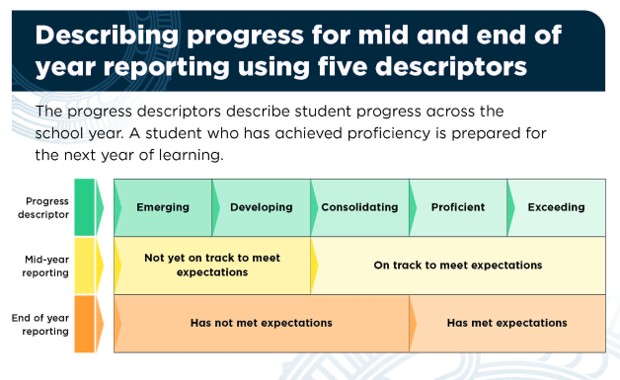
The descriptors are Emerging, Developing, Consolidating, Proficient and Exceeding (see table below from the Ministry of Education). These words describe the different points on the scale. They could just as easily be numbers or different descriptor words. It’s one way to show your child’s progress with their learning regarding the criteria covered in class.
For example, emerging students need support to meet their learning goals, whereas exceeding students are advancing beyond their learning goals.
More information on each descriptor is available here.
What does this mean for my child?
Where the curriculum expectations for learners have changed, your child may have been Proficient (or the equivalent word that your school used to use), but now they’re Consolidating; not because they have ‘gone backwards’ but because the expectations have changed. Remember: reporting is only a snapshot in time.
Think of it like football. If the goalposts move, shots that once scored may now miss. Players need practice to adjust. Some will adapt faster than others. In the same way, new curriculum expectations mean teachers and children need time, knowledge, skills, and practice to meet them.
Learning doesn’t happen in a straight line; sometimes skills take a long time to consolidate and then children jump ahead quickly; sometimes those skills creep along slowly, and we don’t really notice until we look back and realise how far a child has come.
Whether a child is consistently sitting at Exceeding or remains within the Emerging descriptor year-on-year, families need clear information about what progress looks like for their child. This includes understanding how your child is being challenged or, for children with substantial learning needs, how individualised goals and programmes make progress explicit. Goals for learners with complex needs will be based on many factors and achievement may not be adequately captured by the broader progress descriptors.
What matters most is knowing where your child is in their learning and staying connected with your school. We don’t need to be alarmed by this change. Collaboration with your school is the best way to understand learning progress, as teachers draw on assessments, professional judgement, knowledge, and observation behind each mid-year or end-of-year report.
How can I support my child’s learning?
One of the best ways that families can support their children with learning is by providing opportunities for repetition and review at home. When we recall and practise earlier learning, we strengthen memory pathways, making that knowledge easier to use later. A great example of this is learning the times tables. The more we practice learning, rehearsing and storing times tables in memory, the easier it is to retrieve that knowledge when we need it for more complex maths problems.
Children make progress at different rates. When we focus on their strengths, support the harder parts of learning, and model collaboration and connection, we create a safe environment for them to learn and grow.
How can I raise questions/concerns with the school?
If you are concerned about your child’s report, speak to their teacher first, or contact the SENCO, LSC, or Learning Support team at their school.
If you want to understand your child’s progress beyond what is reported and get some tips for how to support learning at home, the questions below can help guide a collaborative conversation with your child’s school. This isn’t about micromanaging teachers, but about building a clearer picture of learning, reducing stress, and making reports feel more meaningful.
- I don’t understand what (insert your query here) means; could you explain why this is important?
- What is being worked on currently in numeracy/literacy?
- What can I do to help reinforce and practice my child’s learning at home?
- What new skills has my child learned recently?
- What strengths is my child showing in their learning currently?
- Is there anything my child is having a hard time learning that we could support at home?
- What are the next steps for my child in their learning journey?
- Where do you expect my child will be at the end of the year based on the new progress descriptors?
For more about learning and asking tricky questions, or to join a free Q&A session, visit my website: www.ntdassessment.co.nz/resources
.jpg)